
Why is the robots.txt file important for SEO?
What the robots.txt file allows or blocks for indexing robots, and the costly mistakes to avoid.
Ensuring a website ranks well in search results is no simple task. There are countless rules to follow, including those concerning indexing robots. Google is unable to manage the indexation of all URLs across a given site. This is why each user must employ the best strategies themselves to optimise the visibility and use of each web page with this tool, and first and foremost, look after their robots.txt file for SEO.
What is the robots.txt file?
In short, robots.txt is a file that serves to distinguish pages to be indexed from others. By implementing this principle, the webmaster is able to guide the actions of indexing robots. When configuring the tool in question, using a specific text editor, the user establishes rules allowing these software programmes used by search engines to sort the URLs that can be exploited and analysed.
That said, it is not a security tool in itself. Nevertheless, it represents an effective measure for addressing the shortcomings of navigation tools. For information, the extension of this file is found at the end of each platform's domain name.
Crawl budget and robots.txt
Crawl budget and robots.txt are closely linked. Based on various parameters, GoogleBot is able to determine the number of pages likely to be explored. The same applies to other search engines. Crawl budget best represents this possibility. Whilst the file in question maximises the effectiveness of this mechanism.
By focusing on these two principles, the SEO specialist has the ability to concentrate all optimisation efforts on the pages and directories that really matter. This allows for better results.
What is the link between robots.txt and SEO?
Implementing this system is not mandatory in itself. However, any good SEO specialist must give importance to its functions to prevent unsecured or private areas from being put at risk. You must check the presence of the robots.txt file at the root and ensure that the rules it contains allow search engines to index the pages you want to appear in their results. Additionally, you must ensure that complementary rules prevent search engines from indexing unnecessary pages, such as those containing parameters.
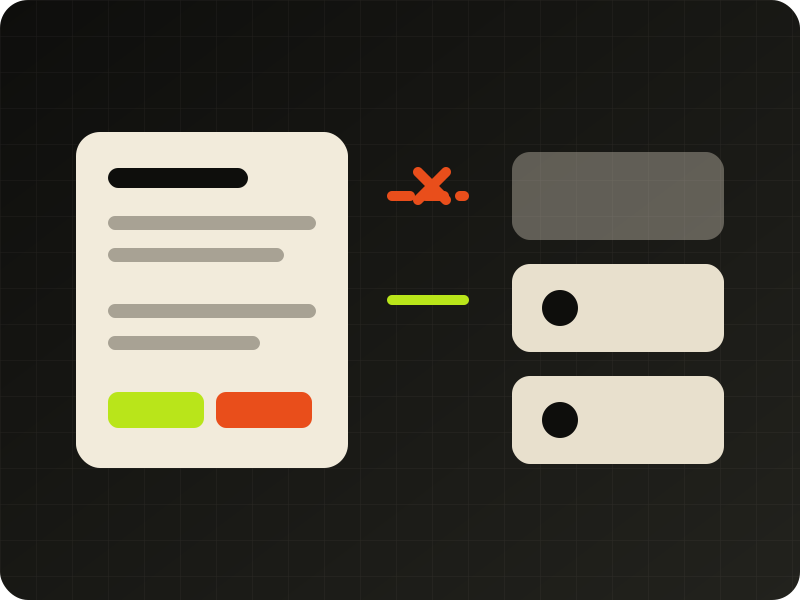
If the site has two halves — one for clients, one for internal staff — the file is essential: only the public area belongs in the index.
A clean robots.txt keeps the search results pointed at the pages that actually help visitors — and keeps duplicate content out of the index altogether.
But for these actions to bear fruit, position monitoring is necessary with regard to the file's configuration, as each mistake costs the site owner dearly. And it is the SEO results that pay the price.
Robots.txt in the age of AI search engines
Recently, your robots.txt no longer speaks only to Googlebot. The crawlers of artificial intelligences — GPTBot (OpenAI), ClaudeBot (Anthropic), PerplexityBot and Google-Extended — also consult it before exploring your site. Yet these robots feed the answers that ChatGPT, Perplexity or Google's AI overviews give to your future customers: blocking them means giving up being cited in these answers.
Our recommendation for a company seeking visibility: explicitly allow these crawlers in your robots.txt, and go further by publishing an llms.txt file at the root of your site — a structured summary of your business and key pages, designed to be read by AI assistants. This is what we apply to our own sites and those of our clients.