
Custom website or template: how should you choose?
Compare templates, configured content management systems and custom development through content, journeys, integrations and operating constraints.
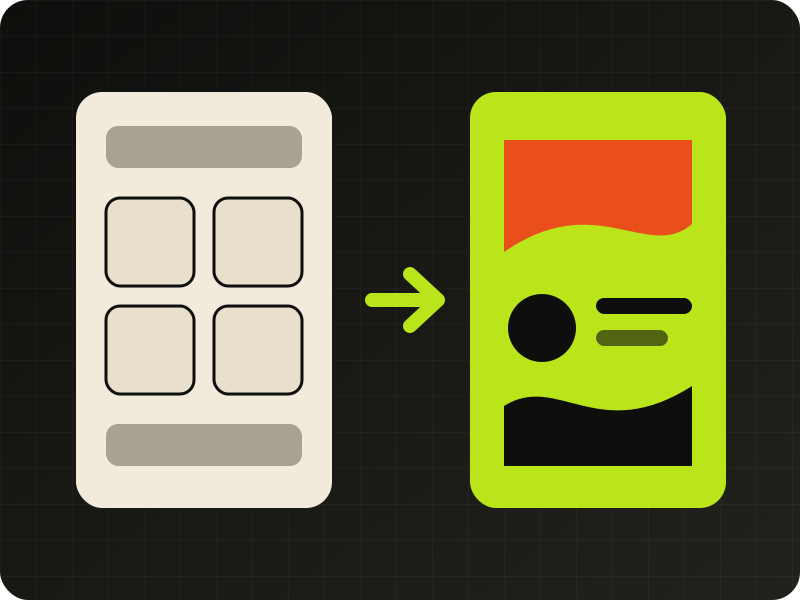
A custom website is not always necessary. A well-configured template with strong content can serve a common requirement very effectively. Conversely, forcing an unusual project into a standard model may create workarounds that are expensive to maintain.
The decision is therefore not about the prestige of a technology. It is about the gap between the organisation’s real needs and what an off-the-shelf solution can support cleanly.
What “custom” actually means
The market often presents templates and fully bespoke development as two opposites. In practice, there are several levels:
- a template used with few changes;
- a theme adapted to the organisation’s identity;
- a standard CMS with custom components and page models;
- a dedicated front end connected to a CMS;
- a platform designed around specific journeys and business rules.
A website can look distinctive without rebuilding every technical foundation. It can also use a familiar CMS while reserving custom development for the capabilities that create genuine value.
When a template or standard product is enough
An existing foundation is usually appropriate when the website mainly presents an organisation, its services, references and contact details. It can also work well when content follows familiar formats and integrations are common: forms, newsletters, maps, appointment requests or a simple catalogue.
This approach leaves more attention for the factors that determine the quality of the website:
- a clear value proposition;
- an understandable content structure;
- original copy and imagery;
- a carefully designed mobile experience;
- an editing interface the team can use;
- defined maintenance and ownership.
A template becomes a constraint when its limits dictate the content or require an accumulation of fragile plug-ins and fixes.
When a custom website becomes relevant
Dedicated development is worth considering when several of the following situations apply.
The journey is not a conventional brochure website
A configurator, advanced search, client area, booking flow with business rules or unusual editorial experience may exceed what a standard theme can provide safely.
Data comes from several systems
CRM, ERP, catalogue, partner portal or internal data may need to be synchronised. The project must then handle permissions, failures, duplicates and recovery, not only page display.
Content has a specific structure
A multilingual organisation may need precise relationships between services, markets, case studies and teams. Controlled blocks and a clear editorial model prevent every page from becoming an unmaintainable free-form layout.
The interface supports a business advantage
If a journey helps the organisation sell, deliver, qualify or retain customers in a distinctive way, a custom experience may be justified. That value should be described and tested before the whole system is built.
Operating constraints are significant
Accessibility, permissions, traceability, performance, security, data retention or publishing workflows may require more control than an off-the-shelf product provides.
A hybrid approach is often the most practical
Choosing custom development does not mean rebuilding everything. A hybrid architecture can retain a proven CMS for content, use dedicated components for identity and journeys, and connect only the systems that are necessary.
This reduces the custom surface that must be maintained while preserving the differentiating parts. It also avoids recreating standard capabilities such as editing, media management or forms when an existing product already covers them well.
Compare total cost, not only launch price
The initial quote is not enough to compare options. The decision should also include:
- content preparation and migration;
- licences, plug-ins and third-party services;
- hosting, monitoring and backups;
- security updates;
- planned development;
- dependency on one supplier or theme;
- the team’s ability to publish without assistance;
- portability of data and code.
A low-cost launch can become expensive if every change needs a workaround. Custom development can also be excessive when the requirement is common and stable.
Seven questions before deciding
- Which outcomes and journeys must the website genuinely support?
- Which capabilities are standard and which are specific to the organisation?
- Who creates, translates, approves and updates content?
- Which systems must exchange data with the website?
- Which constraints are mandatory from launch?
- Which developments are likely over the next two years?
- Who will own operations, security and maintenance?
A short discovery phase often shows that a configured CMS is sufficient. When it reveals a genuinely specific requirement instead, it also defines what deserves custom development — and what does not.
Explore our web development approach to shape a scope that fits your organisation.