
Why implementing a monolithic ERP in 2026 is a major strategic mistake for your SME
Real cost, rigidity and lock-in: what a monolithic ERP imposes on an SME, and what you can do instead.
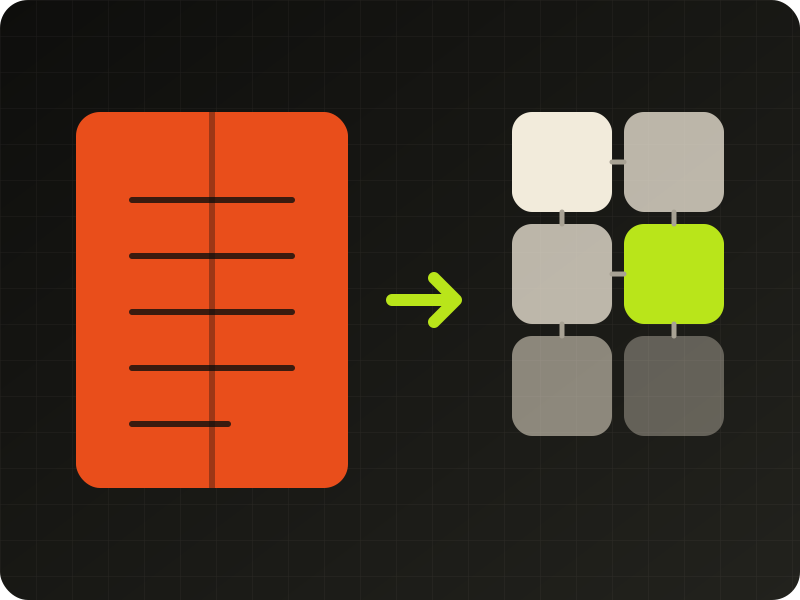
Why implementing a monolithic ERP in 2026 is a major strategic error for your SME
Over the past two decades, the digitalisation roadmap for Swiss SMEs seemed clearly laid out: beyond a certain size, you had to abandon your Excel files and invest in a large integrated management software (ERP) such as SAP, Odoo or Microsoft Dynamics.
The promise was attractive: centralise everything in a single world-renowned tool.
Yet in 2026, committing to this type of massive project has become one of the most dangerous strategic errors for an SME. Behind the glossy brochures lies a harsh reality: budgets that spiral out of control, years of deployment, and teams that end up hating the tool.
Why do so many companies still fall into this trap? And above all, what is the alternative in the age of Artificial Intelligence? Let's break it down.
The "Too Big to Fail" syndrome: Political insurance
If monolithic ERPs continue to be sold at premium prices, the reason is not technological. It is purely psychological.
In the world of enterprise IT, there is an old saying: "Nobody ever got fired for buying IBM." Today, you could say the same thing about SAP or Odoo.
For a decision-maker or IT manager, entrusting the heart of their company to a global leader is political cover. The illusion of security is strong:
- "It's an international solution, it has proven itself."
- "If our integrator goes bankrupt, another partner can take over the project."
- "If the project fails, management cannot blame me for choosing the market leader."
The problem? This apparent "security" masks a rigidity that will suffocate the company's agility.
When giants stumble: The ERP project carnage
You might think that only small integrators fail. Recent tech history proves exactly the opposite. The world's largest companies have come unstuck on these monoliths.
The most emblematic case remains that of Lidl. The retail giant spent 7 years attempting to deploy the SAP S/4HANA system (eLWIS project) to unify its inventory management. The result? The project was completely abandoned after consuming nearly 500 million euros. Lidl ultimately had to revert to its old internal system.
What caused this disaster? A pitched battle between Lidl's actual business processes (which valued inventory at purchase price) and the standard imposed by the software (which imposed valuation at selling price). To work around this rigidity, thousands of hours of "customisation" were billed, turning the software into an unstable monstrosity.
And Lidl is not an exception. Revlon, Target, FoxMeyer and more recently the Société de l'assurance automobile du Québec (SAAQ) have all suffered severe operational paralysis following failed ERP deployments.
If these multinationals, armed with virtually unlimited budgets, fail to tame these systems, why would a 50-person SME succeed more easily?
The 3 flaws of monolithic ERPs in the age of AI
If traditional ERPs are now obsolete, it is because they were designed in the 1990s, long before the Artificial Intelligence and Cloud revolution.
1. Technology that dictates how you work
The promise of ERPs is to bring you the "best practices in the industry". In reality, this means you must bend your internal processes to fit the software's boxes. You lose what makes your company unique and efficient in order to conform to a generic standard.
2. The myth of the "all-in-one" tool
You are sold a tool capable of handling accounting, CRM, HR and inventory. In practice, an SME uses only 15% of an ERP's features. Yet it pays for the complexity, licences and weight of the full 100%. The interfaces are so poorly designed that employees often secretly recreate Excel files to get their work done.
3. The inability to integrate modern AI
Trying to graft today's Artificial Intelligence capabilities (LLMs, predictive analysis, autonomous agents) onto the closed architecture of a 15-year-old ERP is like installing a cutting-edge electric motor in a steam locomotive.
The new standard: Modular and Custom-Built Architecture
Today, the paradigm of software engineering has completely reversed: technology must fit your business 100% and not the other way around.
At Play Digital, we are convinced (and we prove it every day to our clients) that the future belongs to composable architecture and custom development.
Thanks to our own AI building blocks that generate repetitive code (boilerplate, tests, security), we develop custom business software 3 times faster than a traditional agency, with a budget that is fully under control.
The modern approach consists of:
- Creating an ultra-streamlined application core that does ONLY what your teams actually need, with an interface designed for humans.
- Connecting specialist tools via APIs (a real CRM like HubSpot connected to a real accounting tool), rather than using the mediocre modules of an "all-in-one" software.
- Integrating AI natively (OCR for reading your documents, semantic search on your internal data) to automate your real bottlenecks.
Managerial courage in 2026
The greatest challenge for a business leader today is no longer technological. It is managerial.
Showing leadership in 2026 is no longer about signing a six-figure cheque for a global ERP to cover yourself in case of failure. True courage is choosing agility. It is building a modular information system that your company owns 100% and that restores momentum and peace of mind to your teams on the ground.
Do you feel that your current tools are holding you back or are you hesitant to embark on a major digitalisation project? Don't let complexity decide for you. Book a call with us for a 30-minute discussion to audit your architecture.